



Spend any time around an arable farm and you’ll know – timing is everything. Windows are tight, margins tighter, and when things go wrong, they tend to do so at exactly the worst moment.
 That’s what makes machinery theft more than just an inconvenience. It’s not just about the value of what’s taken – it’s about when it’s taken.
Out in the countryside, the reality doesn’t always match the postcard image. Rural crime is organised, targeted and persistent. GPS units disappear from tractor roofs overnight. Quad bikes are lifted in minutes. Larger kit – telehandlers, tractors – can be gone before anyone notices, often moved on or out of the country within hours.
And when that happens mid-season, the impact isn’t theoretical. It’s immediate.
A problem that hasn’t gone away
Figures from the 2025 NFU Mutual Rural Crime Report make it clear this isn’t a marginal issue. Machinery theft continues to cost millions each year, with quad bikes and ATVs among the most commonly targeted with around 1,000 stolen annually across England and Wales.
This isn’t opportunistic crime. It’s planned, it’s efficient and increasingly it’s difficult to counter with traditional measures alone.
 Why CESAR has become the baseline
Against that backdrop, the industries official security and registration scheme, CESAR, has quietly become part of the fabric of modern farm security.
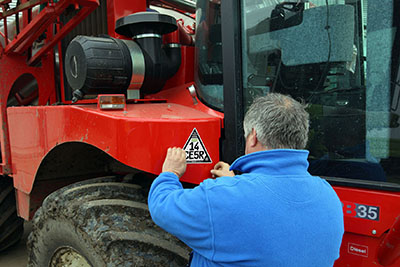
As the UK’s only police-approved equipment registration scheme, CESAR works on a simple principle: make machinery harder to steal – and even harder to sell on.
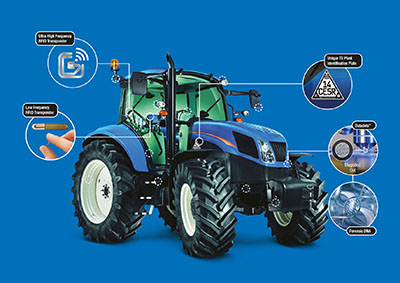
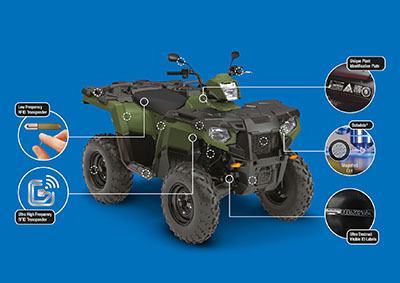
CESAR achieves this through a combination of visible and covert marking supplied by security marking experts DATATAG. The familiar white triangular identification plates act as an immediate and visible deterrent. Backing this up and carefully concealed beneath the surface, high frequency RFID transponders, microscopic Datadots®, unique forensic DNA and a secure national police accessible database give every machine a traceable identity that’s extremely difficult to remove.
It’s not about making bold claims – it’s about shifting the odds. And in practice, CESAR marked machines are far less attractive targets.
 From factory floor to farmyard
One of the clearest signs of CESAR’s impact is how widely it’s been adopted by the agricultural world. Major manufacturers such as John Deere, JCB and Case New Holland fit it as standard on new machines, and retrofitting older kit not protected is both straightforward and cost-effective.
That growing uptake matters. Theft often comes down to risk versus reward – anything that complicates de-identification or makes resale riskier tends to push criminals elsewhere.
There are practical benefits, too. Many insurers recognise CESAR when setting premiums, with significant savings from major insurers like the NFU Mutual. Unlike subscription-based schemes, CESAR is a one-off installation and registration that stays with the machine for life.
 Seen here, used everywhere
Events like Cereals are about progress – new ideas, new technologies and addressing the realities of modern farming life. Security is an increasingly important part of that conversation, whether it’s front of mind or not.
CESAR isn’t new, and that’s part of its strength. It’s a proven, widely recognised scheme backed by the industry and is increasingly expected by end users.
Because while the setting might be picturesque – even here at Diddly Squat – the challenges facing farmers are anything but. And when it comes to protecting the kit that keeps everything moving, practical solutions still count for a lot.
CESAR: Agricultural machine security made simple.
Visit Stand 222.
T +44 (0)1784 778310
info@cesarscheme.org
www.cesarscheme.org
www.datatag.co.uk